
Jordanian Culture: The Heart and Soul of Jordan
Jordan is famous for Petra, Wadi Rum, the Dead Sea, ancient Roman cities, desert landscapes, and thousands of years of history. But for many visitors, the strongest memory of Jordan is not a monument or landscape.
It is the people.
Jordanian culture is shaped by hospitality, family, generosity, respect, faith, community, and traditions passed from one generation to another. These values can be experienced everywhere—from a family home in Amman and a coffee shop in Downtown Amman to a village in northern Jordan or a Bedouin camp beneath the stars of Wadi Rum.
To understand Jordan, therefore, it is not enough to visit its famous attractions. You need to experience its food, conversations, neighborhoods, celebrations, markets, music, customs, and everyday life.
Hospitality: At the Heart of Jordanian Culture
Hospitality is one of the defining characteristics of Jordanian society.
Welcoming a guest is traditionally considered an honor, and generosity toward visitors extends far beyond hotels and restaurants. Travelers may find themselves offered coffee in a shop, invited to drink tea, helped with directions, or drawn into a friendly conversation with someone they have only just met.
In a Jordanian home, guests are commonly offered something to drink or eat soon after arriving. Hosts may continue encouraging their guests to eat, even after everyone appears to be full.
This is more than simple politeness. Hospitality has deep roots in Jordan’s social traditions and is particularly associated with Arab and Bedouin customs of welcoming and protecting guests.
For many international travelers, these spontaneous human encounters become as memorable as Jordan’s famous landmarks.
Arabic Coffee: A Symbol of Welcome and Respect
Arabic coffee is much more than a drink in Jordan.
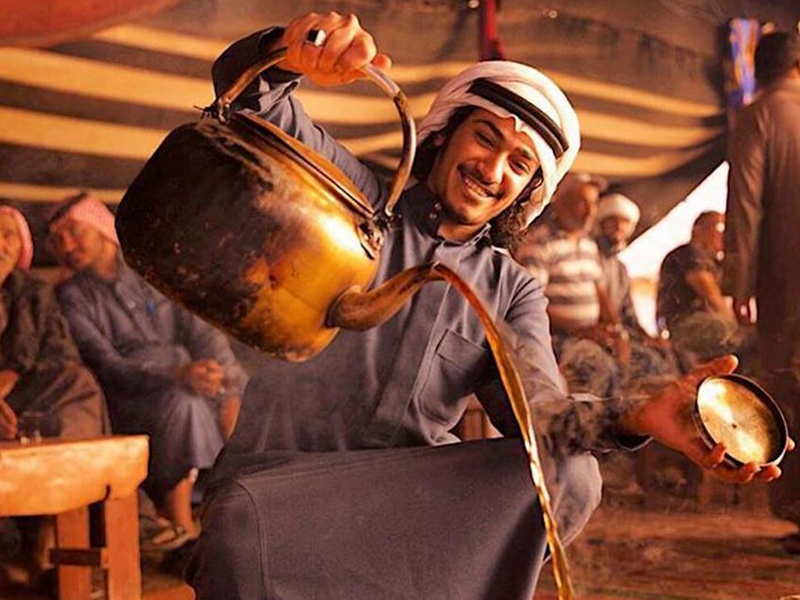
Known locally as qahwa sada, traditional Arabic coffee is commonly prepared with cardamom and served in small cups. It plays an important role in welcoming guests, family gatherings, celebrations, condolences, tribal occasions, and other social settings.
The host traditionally pours a small amount into the cup and may refill it several times.
If you have had enough, gently shaking the cup when returning it is a traditional way of indicating that you do not want another serving.
Tea is equally woven into everyday Jordanian life. Sweet black tea—sometimes flavored with mint or sage—is enjoyed in homes, workplaces, cafés, shops, and desert camps.
Sitting over tea or coffee is often an invitation to slow down and talk.
Family and Community
Family occupies a central place in Jordanian life.
Extended families frequently maintain close relationships, and family gatherings, shared meals, weddings, holidays, and visits are important parts of social life.
Respect for parents and older family members remains an important cultural value, while relatives often provide one another with practical and emotional support.
This emphasis on relationships extends beyond immediate family. Neighbors, friends, colleagues, and local communities can form strong social networks.
Visitors may notice that Jordanians often spend considerable time talking over coffee or meals. Social interaction is not necessarily something squeezed between other activities—it is itself an important part of life.
Jordanian Food: Culture Served at the Table
To understand Jordanian culture, sit at a Jordanian table.
Food is closely connected with hospitality, celebration, family, and community. Large meals are often designed to be shared rather than eaten individually.
Jordan’s best-known traditional dish is mansaf, made with lamb, rice, and jameed, a fermented and dried yogurt traditionally associated with Bedouin food culture.
Mansaf is particularly connected with important gatherings and occasions and has become a powerful symbol of Jordanian identity and hospitality.
But Jordanian food culture extends far beyond mansaf.
Visitors can discover dishes and foods such as maqluba, musakhan, zarb, galayet bandora, falafel, hummus, mutabbal, kibbeh, shawarma, makmoura, and many regional specialties.
Desserts and sweets are another important part of the experience, with kunafa, qatayef, baklava, warbat, and traditional pastries found throughout the country.
Jordanian cuisine also changes from place to place. Northern villages, Amman neighborhoods, Bedouin communities, Circassian and Chechen communities, and towns across the country contribute their own flavors and traditions to Jordan’s food story.
Eating Mansaf the Traditional Way
Visitors may occasionally encounter mansaf served traditionally on a large communal platter.
Traditionally, people may stand around the platter and eat using the right hand, shaping rice and meat into manageable portions. In restaurants and many homes, however, spoons and plates are completely normal.
If you are invited to a traditional meal, there is no need to worry about knowing every custom. Watch your hosts, follow their lead, and ask if you are unsure.
Jordanians generally appreciate visitors who are interested in learning about local traditions.
Greetings and Everyday Social Etiquette
Greetings are important in Jordan and can be warmer and longer than visitors from some cultures may expect.
A common greeting is:
As-salamu alaykum — Peace be upon you.
The response is:
Wa alaykum as-salam — And peace be upon you.
You will also frequently hear marhaba, meaning hello or welcome.
Handshakes are common, particularly between people of the same gender. When greeting someone of another gender, however, it can be polite to wait and see whether the other person extends a hand first.
Among friends and relatives, greetings may include embraces or cheek kisses.
Taking a moment to greet people before beginning a conversation, asking a question, or conducting business is generally appreciated.
Respect and Dress in Jordan
Jordan is welcoming to international visitors and accustomed to many different cultures and styles of dress.
At the same time, social norms tend to be more conservative than in many Western countries, particularly outside major tourist areas.
There is no single dress rule for visitors, but modest clothing can be appropriate when visiting traditional neighborhoods, villages, religious sites, or family homes.
At mosques and other religious locations, visitors should follow the specific dress requirements of the site.
The key is not complicated: observe your surroundings and show the same respect you would expect when entering an important cultural or religious space anywhere else in the world.
Religion and Everyday Life
Religion is visible in daily life throughout Jordan.
The call to prayer can be heard from mosques across cities and villages, and Islamic holidays and traditions influence the rhythm of the year for much of the population.
Jordan is also home to historic Christian communities, churches, pilgrimage sites, and important Christian heritage.
Mosques and churches can be found within the same cities and communities, and Jordan’s religious heritage forms an important part of the country’s history and identity.
Visitors interested in this dimension of Jordan can explore everything from neighborhood mosques and historic churches to major religious destinations such as Mount Nebo, Madaba, and the Baptism Site.
Experiencing Jordan During Ramadan
Ramadan offers visitors a particularly interesting opportunity to observe an important aspect of Jordanian social and religious life.
During the fasting month, daily routines change. Many Muslims fast from dawn until sunset, and evenings become especially lively after iftar, the meal that breaks the fast.
Families gather, restaurants fill, sweets shops become busy, and streets can remain active late into the night.
Visitors are not expected to fast, but being considerate about eating, drinking, or smoking openly around people who are fasting—particularly away from tourist environments—is appreciated.
Ramadan evenings can reveal another side of Jordanian culture, filled with family visits, food, charity, social gatherings, and traditional sweets such as qatayef.
Weddings, Dabke and Celebrations
Jordanian weddings can be energetic, joyful, and deeply connected to family and community.
Music, large gatherings, traditional customs, food, and dancing may all form part of the celebration.
One of the most recognizable dances is dabke, a traditional group dance performed across Jordan and the wider Levant. Dancers form a line or semicircle, joining hands or shoulders while moving rhythmically to the music.
Dabke can be seen at weddings, festivals, cultural events, and national celebrations.
Music styles and wedding traditions vary between families, regions, and communities, giving visitors another window into Jordan’s cultural diversity.
Bedouin Heritage and Desert Culture
Bedouin heritage is an essential part of Jordan’s cultural story.
For centuries, Bedouin communities developed traditions suited to life in the desert and semi-arid landscapes, with deep knowledge of the environment, navigation, animals, water sources, weather, and survival.
Hospitality, poetry, storytelling, coffee rituals, music, tribal relationships, and traditional food all form part of this heritage.
Wadi Rum is one of the most accessible places for visitors to encounter aspects of Bedouin culture today.
Staying in a desert camp, drinking tea around a fire, eating food prepared underground, exploring the desert with local guides, and listening to stories beneath the night sky can create a much deeper connection with the landscape.
It is important, however, to remember that Bedouin culture is a living culture—not simply a tourist attraction.
Traditional Clothing and Embroidery
Traditional Jordanian clothing reflects regional identity, family heritage, craftsmanship, and history.
Women’s traditional dresses can feature intricate hand embroidery, with patterns and styles historically differing between regions and communities.
Traditional men’s clothing may include garments such as the thobe, shemagh or keffiyeh, and agal, although styles and terminology vary.
Today, most Jordanians wear contemporary clothing in everyday life, particularly in cities. Traditional clothing remains especially visible during weddings, festivals, national occasions, heritage events, and in some rural and Bedouin communities.
Jordanian Handicrafts
Jordan’s cultural heritage can also be discovered through its crafts.
Traditional and contemporary artisans work with embroidery, mosaics, ceramics, weaving, jewelry, wood, glass, leather, and other materials.
Different parts of Jordan are associated with different traditions. Madaba, for example, is famous for mosaics, while weaving and textile traditions are strongly connected with Bedouin heritage.
Buying directly from local artisans, cooperatives, and community projects can also turn a souvenir into a meaningful connection with the people who made it.
Souqs and Markets: Culture in Everyday Motion
Some of the best places to observe everyday Jordanian culture are its traditional markets.
Walk through a busy souq and you may encounter spice merchants, vegetable stalls, bakeries, sweet shops, coffee roasters, clothing stores, perfume shops, restaurants, street vendors, and generations-old family businesses.
Downtown Amman—Al Balad—is one of the best places to experience this atmosphere.
The area brings together markets, historic buildings, mosques, churches, Roman ruins, restaurants, cafés, stairways, shops, and constant street life.
Rather than simply walking through, stop for a coffee, taste something from a bakery, browse the shops, and talk to people.
Jordanian culture often reveals itself in these small moments.
Amman: Where Old Jordan Meets New Jordan
Amman provides one of the clearest examples of how tradition and modernity coexist in Jordan.
In Downtown Amman, visitors can experience old markets, traditional restaurants, historic cafés, popular sweet shops, and heritage buildings.
Move toward Jabal Amman and Rainbow Street, and the atmosphere begins to change. Galleries, restaurants, cultural spaces, boutiques, and contemporary cafés sit alongside older homes and architecture.
In Jabal Al Weibdeh, another side of the city emerges through art spaces, cafés, studios, historic houses, and a creative community.
Elsewhere in modern Amman, shopping malls, international restaurants, technology companies, startups, universities, luxury hotels, and contemporary residential districts show a completely different side of Jordanian life.
These worlds are not separate. Together, they are modern Jordan.
Jordan’s Cultural Diversity
Jordanian culture cannot be reduced to one tradition.
The country’s identity has been shaped by numerous communities, migrations, regions, and historical influences.
Bedouin traditions form an important part of the national story, while Circassian, Chechen, Christian, Palestinian, Armenian, and other communities have also contributed to Jordan’s social and cultural landscape.
Cities, villages, desert communities, and different regions have their own foods, accents, customs, architecture, and stories.
This diversity is one of the reasons traveling through Jordan can feel very different from simply staying in one place.
Language: A Few Arabic Words Go a Long Way
Arabic is Jordan’s official language, while English is widely understood in many hotels, restaurants, tourist attractions, and businesses, particularly in Amman and major visitor destinations.
Learning even a few Arabic words can make interactions more enjoyable.
Marhaba — Hello
Ahlan wa sahlan — Welcome
Shukran — Thank you
Min fadlak / min fadlik — Please
Yalla — Let’s go / come on
Tayyib — Okay / good
You certainly do not need to speak Arabic to travel through Jordan, but attempting a few local expressions often leads to smiles and conversations.
Photography and Respect
Jordan offers extraordinary opportunities for photography, from ancient architecture and colorful markets to desert landscapes and street life.
When photographing people, however, asking permission is a good habit—particularly in traditional communities and when taking close portraits.
The same principle applies to private homes, religious ceremonies, weddings, and personal moments.
Sometimes the conversation that begins when you ask permission becomes more memorable than the photograph itself.
How to Experience Jordanian Culture as a Visitor
The best cultural experiences in Jordan do not necessarily require a ticket.
Spend time walking through Downtown Amman. Eat at a traditional restaurant. Visit a neighborhood bakery early in the morning. Drink Arabic coffee. Explore a local market. Visit an artisan workshop. Stay overnight in Wadi Rum. Attend a cultural event. Try Jordanian dishes you have never tasted before. Visit both historic and modern neighborhoods.
Most importantly, leave room in your itinerary for conversations.
Jordan is a country where an ordinary interaction can unexpectedly become one of the highlights of your trip.
Why Jordanian Culture Stays With Travelers
Petra may be the photograph visitors show when they return home.
Wadi Rum may be the landscape they remember.
But Jordan’s human experiences are often what transform a trip into a personal memory.
A shopkeeper who stopped to help.
A family who offered food.
A cup of tea in the desert.
A conversation that lasted longer than expected.
A crowded table surrounded by people.
A stranger saying, “Welcome to Jordan.”
These moments explain something fundamental about the country: Jordan’s heritage is not only preserved in archaeological sites and museums.
It is alive in its homes, streets, kitchens, cafés, markets, celebrations, traditions, and communities.
Discover Jordanian Culture with Ordonna
Ordonna helps you go beyond simply seeing Jordan and start experiencing it.
Discover traditional restaurants and local food, cafés and coffee houses, cultural attractions, historic neighborhoods, handicrafts, markets, museums, local experiences, Bedouin camps, hotels, resorts, events, and places across Jordan.
Explore the famous landmarks—but also walk through the neighborhoods, taste the food, meet the people, listen to the stories, and discover the everyday traditions that make Jordan unique.
Because the story of Jordan is not only written in its ancient stones.
It continues every day through its people.